Neapolitan Revolution of 1820
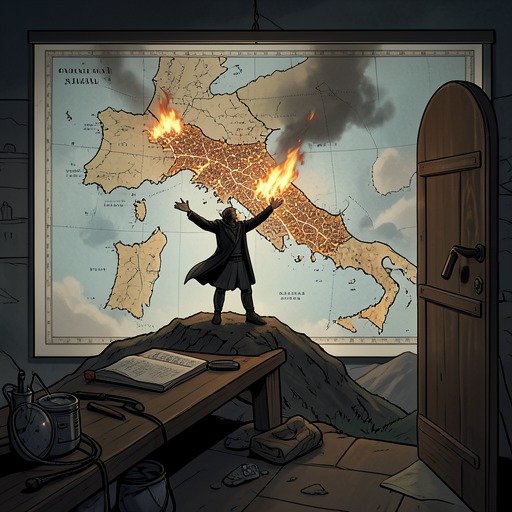
The Florios of SicilyThe Neapolitan Revolution of 1820 is a mainland uprising that compels Ferdinand I to accept a constitutional charter and establish a parliament. In the novel, it becomes both a model and an opening for Sicilian revolt: the constitutional crisis revives the question of Sicily’s autonomy, while the ensuing political disorder reaches directly into the Florios’ commercial world.
Causes and constitutional crisis
The revolt begins when army units in Naples rebel. The discovery that many officers belong to the Carbonari, followed by soldiers joining the insurgents under their commanders, rapidly puts Ferdinand I in difficulty. A few days earlier, the king had already been forced to grant a constitutional charter recognizing rights of the aristocracy and the people and establishing a parliament. The rebellion turns that concession into a broader challenge to royal authority.
For Sicily, the crisis reopens a grievance left by the Bourbon settlement of 1816. The king had abolished the Kingdom of Sicily and repealed its 1812 constitution. Under the subsequent administration, Neapolitans held state and customs offices and military commands; Palermo lost political independence, while heavier taxes and restrictions on trade compounded economic distress. The mainland revolt therefore offered Sicilians not merely a constitutional example, but an opportunity to contest a political subordination that had already altered both government and commerce.
The Sicilian response
During the Feast of Saint Rosalia, on July 14, 1820, Sicily’s own revolt breaks out as the mainland crisis intensifies. Nobles, intellectuals, and others seize the moment to declare Sicilian independence, expressing a desire to cease living as prisoners in their own homes. The uprising’s aims, however, are not politically uniform. The aristocracy is a central force: its members resent the Bourbons for stripping them of power, privileges, and the offices they believed Sicilians should hold over Sicily.
A broader account of the period emphasizes the divisions that weaken resistance to Bourbon restoration. Palermo, Messina, Trapani, and Catania distrust or oppose one another, despite a shared hostility toward rule from beyond the Strait of Messina. The Sicilian independence-seeking government seeks to restore the Kingdom of Sicily, while the Bourbons exploit discord among the cities and suppress the revolt. By November the monarchy has been restored and Sicily is again under Neapolitan government. In March 1821, after Ferdinand I appeals to the Holy Alliance, Austrian forces defeat the insurgents and enter Naples on March 24, restoring the king to his throne; they remain until 1827.
Commercial consequences and the Florios
Political upheaval is registered in the novel through the movement—or stoppage—of goods. During the Sicilian crisis, a provisional government and confusion at customs bring outgoing shipping to a halt. Ignazio learns from Ben Ingham that ships have been blocked and hurries to the Customs House, where merchants and seamen crowd the courtyard and armed soldiers attempt to hold them back. The scene makes sovereignty tangible: whoever controls customs and shipping can interrupt trade without first settling the political conflict.
That vulnerability bears on a business already exposed to changing administrations. The Florios store spices in rented rooms within the Palazzo Steri property, in a warehouse behind the customs offices. By keeping goods there until they enter Palermo, wholesalers pay import tariffs only when the goods actually arrive in the city. The arrangement reflects how closely commercial survival depends on access to port infrastructure, customs rules, and the timing of taxation.
The later Bourbon era brings a different combination of political authority and economic policy. Under Ferdinand II, who becomes king in 1830, the government promotes infrastructure, engineering, railways, metal-hulled warships, electrical street lighting, and improved exploitation of sulfur deposits. Yet the state’s ambitions do not remove conflict over resources: efforts to improve sulfur production provoke an open dispute with British and French buyers seeking to purchase below market prices. Across these episodes, political change appears not as distant background but as a contest over who may direct trade, transport, and the island’s material wealth.
A recurring struggle over resources and rule
The revolution’s legacy also shapes later scenes in which the Florios are pressed to serve competing regimes. During the 1848 uprising, Vincenzo tells Giulia that he has bought a large consignment of rifles in England for the revolutionary committee. Ships have been requisitioned, and the revolutionary government has effectively forced the family to lend it money. The trading business has fallen by half; the company vessel Palermo, once working at full capacity, has been taken to transport troops. Vincenzo’s account shows the cost of political participation to a merchant whose fleet and capital are valuable precisely because they can be commandeered.
When Garibaldi’s forces approach in 1860, Vincenzo acts in his capacity as trade governor to secure cash and bank drafts in the Royal Bank’s safe until the crisis passes. He expects the gold in the treasury to be requisitioned, and anticipates that the money may later be released into circulation or converted into a new currency. After unification, he argues that the Piedmontese have made Sicily a colony and taken the Bourbon Crown’s treasury to Piedmont to finance annexation. The changing regimes alter the names and destinations of authority, but the question raised in 1820 persists: who controls Sicily’s government, its revenues, and the commercial resources on which its people depend?